After Effects Cc How to Disable Black Vertical Line When Ram Review
- Later on Effects User Guide
- Beta releases
- Beta Program Overview
- Later on Effects Beta Home
- Features in Beta
- Properties panel (Beta)
- Getting started
- Go started with Later on Effects
- What's new in After Furnishings
- Release Notes | Subsequently Effects
- Subsequently Effects organisation requirements
- Keyboard shortcuts in Later on Effects
- Supported File formats | Afterward Effects
- Hardware recommendations
- After Furnishings for Apple silicon
- Planning and setup
- Setup and installation
- Workspaces
- General user interface items
- Get to know After Effects interface
- Workflows
- Workspaces, panels, and viewers
- Projects and compositions
- Projects
- Composition nuts
- Precomposing, nesting, and pre-rendering
- View detailed performance data with the Limerick Profiler
- CINEMA 4D Composition Renderer
- Importing footage
- Preparing and importing nevertheless images
- Importing from Afterwards Effects and Adobe Premiere Pro
- Importing and interpreting video and sound
- Preparing and importing 3D image files
- Importing and interpreting footage items
- Working with footage items
- Detect edit points using Scene Edit Detection
- XMP metadata
- Text and Graphics
- Text
- Formatting characters and the Character panel
- Text furnishings
- Creating and editing text layers
- Formatting paragraphs and the Paragraph panel
- Extruding text and shape layers
- Animative text
- Examples and resources for text blitheness
- Live Text Templates
- Motility Graphics
- Work with Motion Graphics templates in Later on Effects
- Use expressions to create driblet-downward lists in Motility Graphics templates
- Work with Essential Backdrop to create Motility Graphics templates
- Supplant images and videos in Motion Graphics templates and Essential Properties
- Text
- Cartoon, Painting, and Paths
- Overview of shape layers, paths, and vector graphics
- Paint tools: Brush, Clone Stamp, and Eraser
- How to taper shape strokes
- Shape attributes, paint operations, and path operations for shape layers
- Use Offset Paths shape outcome to change shapes
- Creating shapes
- Create masks
- Remove objects from your videos with the Content-Aware Make full panel
- Roto Brush and Refine Matte
- Layers, Markers, and Camera
- Selecting and arranging layers
- Blending modes and layer styles
- 3D layers
- Layer backdrop
- Creating layers
- Managing layers
- Layer markers and limerick markers
- Cameras, lights, and points of involvement
- Animation, Keyframes, Motion Tracking, and Keying
- Animation
- Animation nuts
- Animating with Puppet tools
- Managing and animating shape paths and masks
- Animating Sketch and Capture shapes using After Effects
- Assorted blitheness tools
- Work with Data-driven blitheness
- Keyframe
- Keyframe interpolation
- Setting, selecting, and deleting keyframes
- Editing, moving, and copying keyframes
- Motion tracking
- Tracking and stabilizing movement
- Confront Tracking
- Mask Tracking
- Mask Reference
- Speed
- Fourth dimension-stretching and fourth dimension-remapping
- Timecode and time display units
- Keying
- Keying
- Keying furnishings
- Animation
- Transparency and Compositing
- Compositing and transparency overview and resources
- Alpha channels, masks, and mattes
- Adjusting colour
- Color basics
- Utilize the Adobe Color Themes extension
- Colour management
- Color Correction effects
- Effects and Animation Presets
- Effects and animation presets overview
- Effect listing
- Simulation effects
- Stylize furnishings
- Audio effects
- Distort furnishings
- Perspective effects
- Channel furnishings
- Generate effects
- Transition effects
- The Rolling Shutter Repair consequence
- Blur and Sharpen effects
- 3D Channel effects
- Utility furnishings
- Matte effects
- Dissonance and Grain effects
- Particular-preserving Upscale effect
- Obsolete effects
- Expressions and Automation
- Expression
- Expression basics
- Understanding the expression language
- Using expression controls
- Syntax differences betwixt the JavaScript and Legacy ExtendScript expression engines
- Editing expressions
- Expression errors
- Using the Expressions editor
- Use expressions to edit and access text backdrop
- Expression language reference
- Expression examples
- Automation
- Automation
- Scripts
- Expression
- Immersive video, VR, and 3D
- Construct VR environments in Afterward Effects
- Apply immersive video effects
- Compositing tools for VR/360 videos
- Tracking 3D camera motility
- Work in 3D Blueprint Space
- 3D Transform Gizmos
- Do more with 3D blitheness
- Preview changes to 3D designs real time with the Real-Time Engine
- Add together responsive pattern to your graphics
- Views and Previews
- Previewing
- Video preview with Mercury Transmit
- Modifying and using views
- Rendering and Exporting
- Basics of rendering and exporting
- Consign an After Effects project as an Adobe Premiere Pro project
- Converting movies
- Multi-frame rendering
- Automated rendering and network rendering
- Rendering and exporting still images and still-image sequences
- Using the GoPro CineForm codec in After Effects
- Working with other applications
- Dynamic Link and Later Effects
- Working with After Furnishings and other applications
- Sync Settings in Later on Effects
- Artistic Cloud Libraries in After Effects
- Plug-ins
- CINEMA 4D and Cineware
- Collaboration: Frame.io, and Team Projects
- Collaboration in Premiere Pro and After Effects
- Frame.io
- Install and activate Frame.io
- Employ Frame.io with Premiere Pro and After Furnishings
- Frequently asked questions
- Team Projects
- Get Started with Team Projects
- Create a Team Projection
- Collaborate with Team Projects
- Retentiveness, storage, performance
- Retentiveness and storage
- Improve performance
- Preferences
- GPU and GPU driver requirements for Later Effects
Rendering and exporting overview
Rendering is the creation of the frames of a movie from a composition. The rendering of a frame is the creation of a composited two-dimensional image from all the layers, settings, and other data in a composition that makes up the model for that image. The rendering of a picture is the frame-by-frame rendering of each of the frames that make upward the film. For more than data on how each frame is rendered, see Render order and collapsing transformations.
It is common to speak of rendering as if this term only applies to final output. However, the processes of creating previews for the Footage, Layer, and Composition panels are besides kinds of rendering. In fact, it is possible to save a preview every bit a moving picture and use that as your concluding output. (See Preview video and audio.)
After a composition is rendered for final output, it is processed by ane or more output modules that encode the rendered frames into one or more than output files. This process of encoding rendered frames into files for output is one kind of exporting.
Note :
- See Projection settings for more information well-nigh project settings that determine how time is displayed in the projection, how color data is treated in the project, and what sampling charge per unit to use for sound.
- See Limerick settings to learn how you can specify composition settings such as resolution, frame size, and pixel aspect ratio for your final rendered output.
Later on Effects provides various rendering options that help you lot accelerate the rendering process. GPU acceleration offers better speed and precision in rendering your effects. The Video Rendering and Effects dropdown in the Project Settings dialog box gives y'all the following GPU outcome rendering options to choose from:
- Software Only: CPU is used to return effects
- Mercury GPU Acceleration: GPU is used to return effects. On Mac, Mercury GPU Acceleration can use OpenCL or Metallic. On Windows, GPU issue rendering uses either CUDA or OpenCL based on your option.
Note: GPU-accelerated effects may render with pocket-size color precision differences in an 8-bpc project when compared to CPU-merely rendering. Set the project to 16-bpc or 32-bpc for accurate results.
After yous have completed a composition, you can output a movie file. There are ii different methods of outputting a moving picture file. Cull the 1 based on your needs.
You might demand a movie file for the following reasons:
-
Yous need a high-quality movie (with or without an alpha channel) or prototype sequence that will be placed in a Premiere Pro sequence, or used in another video editing, compositing, or 3D graphics application.
To create a loftier-quality movie file, render it with the Render Queue. Run across Render and export with the Return Queue panel.
-
You need a compressed moving-picture show that will exist played on the web, or used for DVD or Blu-ray disc.
To create a high-quality film file that is compressed for the spider web, DVD, or Blu-ray disc, encode information technology using the Adobe Media Encoder. See The Adobe Media Encoder.
Some kinds of exporting don't involve rendering and are for intermediate stages in a workflow, not for final output. For example, you can export a projection equally an Adobe Premiere Pro project by choosing File > Consign > Adobe Premiere Pro Project. The projection data is saved without rendering. In full general, data transferred through Dynamic Link is not rendered.
A picture show tin be made into a single output file that contains all the rendered frames, or it can be fabricated into a sequence of still images (every bit you would practise when creating output for a film recorder).
To generate output, you lot can either render your compositions using the After Effects return queue or add together your compositions to the Adobe Media Encoder queue with the return settings that you have chosen in the Return Queue panel.
For the Render Queue, Afterwards Effects uses an embedded version of the Adobe Media Encoder to encode most pic formats through the Render Queue panel. When you manage render and consign operations with the Render Queue panel, the embedded version of the Adobe Media Encoder is called automatically. The Adobe Media Encoder appears only in the form of the export settings dialog boxes with which you lot specify some encoding and output settings. (See Encoding and compression options for movies.)
The embedded version of the Adobe Media Encoder used to manage export settings within Subsequently Effects output modules does non provide all the features of the full, stand up-alone Adobe Media Encoder awarding.
Render and export with the Render Queue panel
The primary style of rendering and exporting movies from Afterwards Effects is through the Return Queue panel.
When you place a limerick into the Render Queue panel, it becomes a render item. Y'all can add together many return items to the render queue, and After Effects tin render multiple items in a batch, unattended. When yous click the Return button in the upper-right corner of the Render Queue panel, all items with the status of Queued are rendered and output in the order in which they are listed in the Render Queue console.
Y'all do not demand to render a movie multiple times to export it to multiple formats with the aforementioned render settings. You lot tin can export multiple versions of the same rendered movie past adding output modules to a render item in the Return Queue panel.
When working with multiple render items, information technology is often useful to add comments in the Comment column in the Return Queue panel. If the Comment column is not visible, right-click (Windows) or Command-click (Mac Bone) a column heading, and cull Columns > Comment.
Manage render items
In the Render Queue panel, you lot can manage several render items at once, each with its own render settings and output module settings.
Render settings determine the following characteristics:
- Output frame rate
- Duration
- Resolution
- Layer quality
Output module settings—which are applied after render settings—make up one's mind postal service-rendering characteristics such equally the post-obit:
- Output format
- Compression options
- Cropping
- Whether to embed a link to the projection in the output file
Yous can create templates that contain commonly used render settings and output module settings.
Using the Return Queue panel, you tin render the same composition to different formats or with unlike settings, all with one click of the Return button, for example:
-
You tin can output to a sequence of yet images, such as a Cineon sequence, which you tin can then transfer to film for cinema project.
-
You can output using lossless compression (or no compression) to a QuickTime container for transfer to a non-linear editing (NLE) organization for video editing.
You lot can select, duplicate, and reorder render items using many of the same keyboard shortcuts that you employ for working with layers and other items. See General (keyboard shortcuts).
To transfer the output rendered from Subsequently Effects to film or video, you must take the proper hardware for motion picture or video transfer, or take access to a service bureau that can provide transfer services.
Render and export a film using the render queue
-
Select the composition from which to make a movie in the Project panel, and then practise one of the following to add the composition to the render queue:
-
Select Composition > Add To Render Queue.
OR
-
Drag the composition to the Render Queue panel.
To create a composition from a footage item and immediately add that composition to the return queue, drag the footage item from the Projection panel to the Render Queue panel. It is a user-friendly style to convert a footage item from one format to some other.
-
-
Click the triangle next to Output To in the Render Queue console to choose a name for the output file based on a naming convention, and then choose a location; or click the text adjacent to the Output To setting to enter whatever name. (See Specify filenames and locations for rendered output.)
-
Click the triangle to the right of Return Settings to choose a render settings template, or click the underlined text to the right of the Return Settings to customize the settings. (Run into Render settings.)
-
Choose a Log type from the Log bill of fare.
When a log file has been written, the path to the log file appears under the Return Settings heading and Log menu.
-
Click the triangle to the correct of the Output Module to choose an output module settings template, or click the underlined text to the right ofOutput Module to customize the settings. Yous apply the output module settings to specify the file format of the output motion picture. In some cases, a format-specific dialog box opens after you choose a format, in which you can cull format-specific settings. If you take new preferences as opposed to upgraded or imported preferences, the output module default is set to High Quality.
(Encounter Output modules and output module settings and Encoding and pinch options for movies.)When an output name and location take been set, and render settings and an output module have been selected, the entry in the Render column automatically becomes selected (shown by a bank check marker) and the status changes to Queued. The status Queued ways that the return item is in the render queue.
Press Caps Lock before you start rendering to prevent the Composition panel from displaying rendered frames. By non updating the Composition panel, Subsequently Effects requires less time to process uncomplicated return items with many frames.
-
Click the Render push button in the upper-correct corner of the Render Queue console.
Rendering a composition into a movie tin take a few seconds or many hours, depending on the limerick's frame size, quality, complexity, and compression method. To fasten the process, utilise Multi-Frame Rendering.
See this tutorial to learn how to use the render queue to export files.
When rendering of a render detail is complete, it remains in the Render Queue panel with its status changed to Washed until you remove the item from the Render Queue panel. You cannot rerender a completed detail, simply y'all can indistinguishable information technology to create a new item in the queue with the same settings or with new settings.
After an particular has been rendered, you can import the finished movie equally a footage detail by dragging its output module from the Render Queue panel into the Project panel. (Run across Import footage items.)
Render queue panel options

The Return Queue displays the following data:
- Info button - It displays information such as concurrent frames rendering (depends on the quality), time taken by current frame, get-go frame, and the end frame.

- Elapsed - Fourth dimension already taken while rendering.
- Remaining - Time remaining for the render to complete.
- Estimated size - Estimated size of the rendered limerick.
- Costless infinite - Remaining free infinite on your disk.
The dynamic Current Return bar represents retentivity usage - bright green is frames currently rendering, blueish is frames written to disk, and night dark-green in between is frames that accept been rendered but not written to disk. The more % CPU power is alloted to After Effects, the dark greenish bar appears less, as the rendering and writing to disk procedure is faster.
Render detail statuses
Each return item has a status, which appears in the Condition column in the Render Queue panel:
Unqueued
The return item is listed in the Render Queue console just is not ready to render. Confirm that you have selected the desired render settings and output module settings, and then select the Render selection to queue the render detail.
Queued
The render item is ready to render.
Needs Output
An output filename has non been specified. Choose a value from the Output To menu, or click the underlined Not Withal Specified text side by side to the Output To heading to specify a filename and path.
Failed
Later on Furnishings was unsuccessful in rendering the return detail. Utilise a text editor to view the log file for specific information on why the rendering was unsuccessful. When a log file has been written, the path to the log file appears under the Render Settings heading and Log menu.
User Stopped
The rendering process was stopped.
Done
The rendering procedure for the item is complete.
Manage render items and change render statuses
- Select the source composition for a render item in the Project panel: Right-click (Windows) or Command-click (Mac Os) the return item and cull Reveal Composition In Project from the context carte.
- Remove a render particular from the render queue (change its condition from Queued to Unqueued): Deselect the item entry in the Return cavalcade. The detail remains in the Render Queue console.
- Modify the status of a return item from Unqueued to Queued: Select the detail in the Return column.
- Remove a render item from the Render Queue panel: Select the item and printing Delete, or choose Edit > Clear.
- Rearrange items in the Render Queue panel: Drag an item upwards or down the queue. A heavy blackness line appears between render items, indicating where the item will be placed. Y'all tin besides reorder selected render items by choosing Layer > Accommodate, and and so choosing Bring Render Particular Forrard, Send Return Item Backward, Bring Render Particular To Front, or Ship Return Detail To Dorsum
- Move selected render items up (earlier) in the render queue: Press Ctrl+Alt+Upwardly Arrow (Windows) or Control+Option+Up Pointer (Mac Os).
- Move selected render items downwardly (subsequently): Press Ctrl+Alt+Downwards Pointer (Windows) or Command+Option+Down Arrow (Mac Bone).
- Move selected render items to the top of the return queue: Press Ctrl+Alt+Shift+Up Arrow (Windows) or Command+Option+Shift+Upwardly Pointer (Mac Os).
- Move selected return items to the bottom (end) of the return queue: Press Ctrl+Alt+Shift+Down Arrow (Windows) or Control+Option+Shift+Downwards Arrow (Mac OS).
- Indistinguishable a render particular: Right-click (Windows) or Control-click (Mac Bone) the render item and choose a control from the context menu:
- Render with the aforementioned filename: Choose Duplicate With File Name.
- Return with a new filename: Choose Duplicate, click the underlined filename side by side to Output To, enter a new filename, and click Save.
Pause or finish rendering
If the disk (to which an output module is writing) runs out of infinite, Later on Furnishings pauses the render performance. You lot tin clear additional disk space and and then resume rendering and exporting.
- To pause rendering, click Pause. To resume rendering, click Continue.
While rendering is paused, you cannot alter settings or use After Effects in whatever other style.
- To end rendering with the purpose of starting the aforementioned return over again, Alt-click (Windows) or Option-click (Mac OS) Terminate.
The return particular for which rendering was stopped is assigned the status User Stopped, and a new detail with the status of Queued is added to the Render Queue panel. The new particular uses the same output filename and has the same elapsing equally the original render particular.
- To stop rendering with the purpose of resuming the aforementioned render, click Stop.
The return item for which rendering was stopped is assigned the status User Stopped, and a new detail with the condition of Unqueued is added to the Render Queue panel. The new particular uses an incremented output filename and resumes rendering at the before frame at which rendering was stopped—so the offset frame of the new item is the last successfully rendered frame of the stopped item.
Information shown for electric current return operations
Bones information most the current batch of renders is shown at the bottom of the Render Queue panel:
- Message - A status bulletin. For example, Rendering 1 of 4.
- RAM - Memory available for the rendering process.
- Renders Started - The date and time at which the current batch of renders was started.
- Full Time Elapsed - The rendering time elapsed (not counting pauses) since the current batch of renders was started.
- Notify when render queue completes - Check this box to let After Furnishings notify yous via Creative Cloud desktop app and mobile app when your return queue job, or the entire queue is finished rendering.
To view more than data well-nigh the electric current render operation, click the triangle to the left of the Current Render heading. The Current Render pane collapses (closes) after a brusque time. To forbid it from collapsing after a time-out menstruum, Alt-click (Windows) or Option-click (Mac Os) the triangle next to the Electric current Render heading. To view details of a completed render, review the log file. When a log file has been written, the path to the log file appears under the Render Settings heading and Log menu.
Alter the return-consummate sounds
A chime plays when all items in the render queue have been rendered and exported; a different sound plays if a return performance fails. You tin change the render-complete sounds by replacing files named rnd_okay.wav and rnd_fail.wav in the sounds binder. The sounds folder is in the post-obit location:
-
Programme Files\Adobe\Adobe After Furnishings CC 2015\Support Files (Windows)
-
Applications/Adobe After Furnishings CC/Contents/Resources (Mac OS)
Receive remote notifications when return completes
.png.img.png)
After Effects can send you remotenotifications later on the rendering process is complete, eliminating the need to wait at your machine to know when the files are set. Notifications are sent to your Creative Deject mobile desktop app, your mobile device with the linked Creative Cloud app installed, along with your smart watch linked with your mobile.
To enable, you can select from the following options:
- Select Later on Effects > Notifications. Check the Automatically enable notifications when y'all add together a limerick to the Render Queue box. You lot can open this dialog box past clicking the bong icon at the bottom left of the Render Queue console.
- In the Render Queue panel, check the Notify box. When the above checkbox is enabled, the Notify box is checked by default.
- Check the Notify when render queue completes box at the lesser of the return queue panel.
Y'all tin can also export After Effects compositions directly into Adobe Media Encoder, which offers the flexibility to continue working in After Effects while files are beingness processed. To fasten the process, utilise Mutli-Frame Rendering. When you utilise Adobe Media Encoder, you can also use boosted presets and options that are not available in the After Effects Render Queue.
You can add your composition to the Adobe Media Encoder Queue using ane of the following methods:
- Add to Adobe Media Encoder Queue (Limerick > Add together to Adobe Media Encoder Queue or File > Export > Add together to Adobe Media Encoder Queue) for final rendering using presets and settings specified in Adobe Media Encoder.
- Queue in AME button in the render queue (Window > Render Queue) for rendering a draft copy of your composition using the render settings specified in the rendering queue, while you go along to piece of work on the composition.
For data about using Adobe Media Encoder for rendering, meet Encode video or audio items in Adobe Media Encoder.
Note :
The output module settings, such as format settings or color channel selection, are non transferred to Adobe Media Encoder when you choose the Queue in AME option. The output filename and location are transferred, still, Adobe Media Encoder does not utilise the filename and location templates, which may issue in image sequence numbering mismatch.
To add together a limerick to Adobe Media Encoder, practise the following:
-
Drag the Afterward Effects project containing the composition you want to encode into the Encoding Queue in Adobe Media Encoder.
Yous can add a composition to Adobe Media Encoder from Later on Effects. Practise ane of the following:
-
Cull Composition > Add To Adobe Media Encoder Queue
-
Choose File > Export > Add together to Adobe Media Encoder Queue
-
Printing Ctrl+Alt+M (Windows) or Command+Choice+M (Mac OS)
-
-
The Import Later Effects Limerick dialog box opens. Choose the composition you want to encode.
-
Encode the file as y'all normally would past choosing presets and an output location in Adobe Media Encoder.
To add a limerick to the Adobe Media Encoder with render settings for draft rendering:
-
Choose Composition > Add to Render Queue or printing the keyboard shortcut Control + Thousand (Windows) or Command + K (Mac).
-
In the Render Queue panel, click the Queue in AME button.
Choosing formats and output settings
After Effects provides various formats and pinch options for output. Which format and compression options you choose depends on how your output will exist used. For case, if the motion picture that y'all render from Later on Effects is the final product that volition be played directly to an audience, then you need to consider the medium from which you'll play the movie and what limitations y'all accept on file size and data rate. By contrast, if the pic that you lot create from Afterwards Effects is an intermediate product that will be used equally input to a video editing organization, then you should output without compression to a format compatible with the video editing system. (See Planning your work.)
Proceed in heed the fact that you tin use different encoding and compression schemes for different phases of your workflow. For case, you may choose to export a few frames as total-resolution nevertheless images (for example, TIFF files) when y'all need approval from a customer nearly the colors in a shot; whereas you may consign the film using a lossy encoding scheme (for example, H.264) when y'all need approval for the timing of the animation.
Supported output formats
You lot tin can add the power to export other kinds of data by installing plug-ins or scripts provided by parties other than Adobe.
Unless otherwise noted, all image file formats are exported at 8 $.25 per channel (bpc).
Video and animation formats
-
QuickTime (MOV)
-
Video for Windows (AVI; Windows only)
To create an animated GIF movie, first render and export a QuickTime movie from Afterward Furnishings. Then import the QuickTime movie into Photoshop and export the movie to animated GIF.
- Adobe Premiere Pro project (PRPROJ)
-
Adobe Photoshop (PSD)
-
Cineon (CIN, DPX)
-
Maya IFF (IFF)
-
JPEG (JPG, JPE)
-
OpenEXR (EXR)
-
PNG (PNG)
-
Radiance (HDR, RGBE, XYZE)
-
SGI (SGI, BW, RGB)
-
Targa (TGA, VBA, ICB, VST)
-
TIFF (TIF)
-
Audio Interchange File Format (AIFF)
-
MP3
-
WAV
Collect files in one location
The Collect Files command gathers copies of all the files in a project or composition into a single location. Use this control earlier rendering, for archiving, or for moving a project to a unlike figurer system or user account.
When yous utilise the Collect Files command, After Effects creates a new folder and the post-obit data is saved in the new binder:
- A new copy of the projection
- Copies of the footage files
- Proxy files every bit specified
- A written report describing the files, effects, and fonts necessary to copy the projection and return the compositions.
Later on you lot collect files, you can go along making changes to a project, simply be aware that those changes are stored with the original projection and not with the newly collected version.
-
Choose File > Dependencies > Collect Files.
-
In the Collect Files dialog box, choose an appropriate option for Collect Source Files.
All
Collects all footage files, including unused footage and proxies.
For All Comps
Collects all footage files and proxies used in whatever composition in the project.
For Selected Comps
Collects all footage files and proxies used in compositions currently selected in the Project panel.
For Queued Comps
Collects all footage files and proxies used direct or indirectly in whatsoever of the compositions with a Queued status in the Render Queue panel.
None (Project Simply)
Copies the projection to a new location without collecting any source footage.
-
Select other options, as appropriate:
Generate Study Only
Selecting this option does non copy the files and proxies.
Obey Proxy Settings
Use this choice with compositions that include proxies to specify whether yous want the copy to include the electric current proxy settings. If this selection is selected, only the files used in the limerick are copied. If this option is not selected, the copy contains both proxies and source files, and then y'all can later alter proxy settings in the collected version.
If you cull For Queued Comps in the Collect Source Files dialog box, After Effects uses the proxy settings from the render settings, not the limerick.
Reduce Projection
Removes all unused footage items and compositions from the collected files when the following options are called in the Collect Source Files menu: For All Comps, For Selected Comps, and For Queued Comps.
Change Return Output To
Use to redirect the output modules to render files to a named folder in the collected files folder. This choice ensures that y'all have access to your rendered files when you lot're rendering the project from another calculator. Rendering status must be valid (Queued, Unqueued, or Will Keep) for the output modules to return files to this folder.
Enable 'Lookout man Folder' Render
You can employ the Collect Files command to salve projects to a specified watch folder and then initiate watch-binder rendering over a network. Later on Effects also includes a render command file chosen [projection name]_RCF.txt, which signals to watching computers that the project is available for rendering. After Effects and any installed render engines tin can and then return the project together across a network. (Run into Ready up watch-binder rendering.)
Maximum Number Of Machines
Utilise to specify the number of render engines or licensed copies of Subsequently Effects that you want to allocate to render the collected project. Below this option, After Effects reports how many items in the project will be rendered using more than 1 reckoner.
If rendering fourth dimension is unusually long, you may have set Maximum Number Of Machines too loftier, and the network overhead required to track rendering progress amidst all computers is out of proportion to the fourth dimension spent actually rendering frames. The optimal number depends on many variables related to the network configuration and the computers on information technology; experiment to determine the optimal number for your network.
-
To add your own information to the written report that will be generated, click Comments, enter your notes, and click OK. The comments appear at the cease of the study.
-
Click Collect. Name the folder and specify a location for your nerveless files.
Once you start the file drove, After Furnishings creates the folder and copies the specified files to it. The binder hierarchy is the aforementioned equally the hierarchy of folders and footage items in your project. The new folder includes a (Footage) folder and may include an output folder (if you selected Change Render Output To).
The names of these folders announced in parentheses to signal to any attending render engines that they should not search these folders for projects.
Specify filenames and locations for rendered output
You can locate a previously rendered item or cheque the destination of a queued render particular by expanding the Output Module group in the Render Queue panel and clicking the underlined file path, or by right-clicking (Windows) or Control-clicking (Mac Bone) the Output Module heading.
Specify the filename and location for a unmarried return item
- To manually enter a filename and destination folder, click the underlined text adjacent to the Output To heading.
- To name a file using a file naming template, click the triangle next to the Output To heading, and choose a template from the carte du jour.
Create and use a custom file naming template
You can use custom templates to name the output co-ordinate to properties of the composition and projection.
To brand a file naming template the default template, hold down Ctrl (Windows) or Command (Mac OS) as you lot choose the template from the Output To carte du jour.
-
In the Render Queue panel, choose Custom from the Output To menu.
-
If you want to base the new file-naming template on an existing template, choose the existing template from the Preset menu.
-
Click in the Template box where you want to insert a file-naming rule, and do whatever of the following:
-
To add a preset property to the filename, choose the property from the Add Property carte du jour.
-
Enter text in the Template box.
Brand sure that the insertion indicate is outside the foursquare brackets [ ] of preset properties.
-
-
-
To relieve the file-naming template as a preset for future use in the Output To menu, click the Save button
 . In the Cull Name dialog box, enter a name for the file-naming template, and click OK.
 -
To always apply the selected file-naming template, select Default.
-
To apply the selected file-naming template to the current Output Module, click OK.
-
Proper noun output files automatically
The Apply Default File Proper name And Folder preference ensures that all compositions added to the render queue are automatically assigned a unique output filename (except for files created by saving previews, which nonetheless utilize the limerick name). When this choice is selected, each render item is assigned the aforementioned binder name equally the previous render item until yous change the path. If a composition is rendered more than once, After Effects adds a number to the filename (for example, composition_name_1).
Avoid using high-ASCII or other extended characters in filenames for projects to be used on different platforms or rendered using a sentry folder.
-
Choose Edit > Preferences > Output (Windows) or After Effects > Preferences > Output (Mac OS).
-
Select Utilise Default File Proper noun And Folder.
Support for paths in templates
Yous tin can add paths to templates. Absolute paths can be defined in a template. For example, you tin define and relieve a template that always places rendered files in E:\Output\[compName].[extension].
Return settings
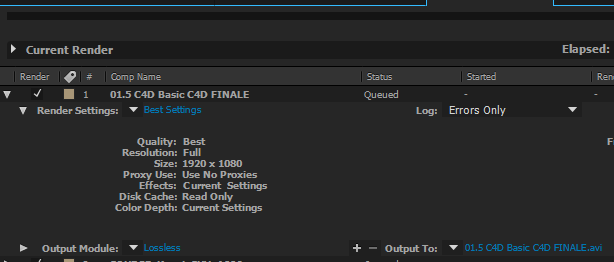
Return settings apply to each render item and determine how the composition is rendered for that specific render detail. By default, the return settings for a render particular are based on the current project settings, composition settings, and switch settings for the composition on which the render item is based. Even so, you can modify the render settings for each render item to override some of these settings.
Render settings apply to the root composition for a render item, equally well as all nested compositions.
Render settings but bear on the output of the return detail with which they're associated; the composition itself is not affected.
Change render settings
- To change render settings for a render item, click the render settings template proper name next to the Return Settings heading in the Render Queue console, and choose settings in the Render Settings dialog box.
- To use a return settings template to selected render items, click the triangle next to the Return Settings heading in the Return Queue panel, and choose a template from the menu. You can choose a custom render settings template or one of the preset render settings templates:
All-time Settings: Frequently used for rendering to terminal output.
Draft Settings: Often appropriate for reviewing or testing motility.
DV Settings: Similar to All-time Settings, but with Field Rendering turned on, set to Lower Field Kickoff.
Multi-Machine Settings: Like to Best Settings, but with Skip Existing Files selected to enable multi-machine rendering.
The default render settings template is assigned to a render particular when it is created. To modify which return settings template is the default, concord down Ctrl (Windows) or Command (Mac OS) as you cull a render settings template from the menu.
Create, edit, and manage return settings templates
You perform the following tasks in the Render Settings Templates dialog box. To open the Render Settings Templates dialog box, choose Edit > Templates > Render Settings, or click the triangle adjacent to the Render Settings heading in the Render Queue panel and choose Brand Template.
- To make a new return settings template, click New, specify return settings, and click OK. Enter a proper noun for the new template.
- To edit an existing render settings template, choose a template from the Settings Proper noun menu, click Edit, and specify render settings.
Changes to an existing template do non affect render items that are already in the render queue.
- To specify a default render settings template to be used when rendering movies, private frames, pre-rendered movies, or proxies, choose a template from a menu in the Defaults expanse of the Return Settings Templates dialog box.
- To save all currently loaded render settings templates to a file, click Save All.
- To load a saved render settings template file, click Load, select the render settings template file, and then click Open.
Render settings reference
Each of these settings overrides composition settings, project settings, or layer switch settings.
Log
You can choose how much information After Furnishings writes to a render log file. If you choose Errors Only, Afterward Effects only creates the file if errors are encountered during rendering. If you choose Plus Settings, a log file is created that lists the current render settings. If you cull Plus Per Frame Info, a log file is created that lists the current return settings and information nigh the rendering of each frame. When a log file has been written, the path to the log file appears nether the Return Settings heading and Log bill of fare.
Quality
The quality setting to utilize for all layers. (See Layer image quality and subpixel positioning.)
Resolution
Resolution of the rendered composition, relative to the original composition dimensions. (Run into Resolution.)
If you lot render at reduced resolution, set the Quality selection to Draft. Rendering at Best quality when reducing resolution produces an unclear image and takes longer than Draft quality.
Disk Cache
Determines whether the disk cache preferences are used during rendering. Read Only writes no new frames to the disk enshroud while Afterwards Effects renders. Current Settings (default) uses the deejay enshroud settings defined in the Media & Deejay Enshroud preferences.
Proxy Use
Determines whether to use proxies when rendering. Current Settings uses the settings for each footage detail. (See Placeholders and proxies.)
Effects
Current Settings (default) uses the current settings for Effect switches  . All On renders all applied effects. All Off renders no effects.
Solo Switches
Current Settings (default) uses the current settings for Solo switches  for each layer. All Off renders equally if all Solo switches are off. (Meet Solo a layer.)
Guide Layers
Current Settings renders guide layers in the height-level composition. All Off (the default setting) does not render guide layers. Guide layers in nested compositions are never rendered. (Encounter Guide layers.)
Color Depth
Current Settings (default) uses the project chip depth. (See Colour depth and loftier dynamic range color.)
Frame Blending
On For Checked Layers renders frame blending only for layers with the Frame Blending switch  set, regardless of the Enable Frame Blending setting for the composition. (Run into Frame blending.)
Field Return
Determines the field-rendering technique used for the rendered composition. Choose Off if you are rendering for film or for display on a computer screen. (See Interlaced video and separating fields.)
3:2 Pulldown
Specifies the stage of 3:2 pulldown. (See Innovate 3:2 pulldown.)
Motion Blur
Current Settings uses the current settings for the Movement Blur layer switch  and the Enable Motion Mistiness composition switch. On For Checked Layers renders motion blur only for layers with the Movement Blur layer switch set, regardless of the Enable Motion Blur setting for the limerick. Off For All Layers renders all layers without motion blur regardless of the layer switch and composition switch settings. (See Motion mistiness.)
Time Bridge
How much of the composition to render. To render the unabridged composition, choose Length Of Comp. To render only the function of the composition indicated by the work area markers, choose Piece of work Surface area Only. To render a custom fourth dimension span, choose Custom. (Meet Work area.)
Frame Charge per unit
The sampling frame rate to employ when rendering the movie. Select Use Comp's Frame Charge per unit to employ the frame rate specified in the Composition Settings dialog box, or select Employ This Frame Rate to utilise a different frame rate. The bodily frame charge per unit of the composition is unchanged. The frame rate of the terminal encoded flick is adamant by the output module settings. (See Frame rate.)
Skip Existing Files
Lets you rerender part of a sequence of files without wasting time on previously rendered frames. When rendering a sequence of files, After Furnishings locates files that are office of the current sequence, identifies the missing frames, and so renders merely those frames, inserting them where they belong in the sequence. You can too employ this option to render an prototype sequence on multiple computers. (See Render a still-image sequence with multiple computers.)
The current image sequence must take the same proper name as the existing image sequence, and the starting frame number, frame charge per unit, and time bridge must exist the same. You lot must render to the folder that contains the previously rendered frames.
Output modules and output module settings
Output module settings apply to each return detail and determine how the rendered pic is processed for final output. Employ output module settings to specify file format, output color profile, compression options, and other encoding options for final output.
You lot can also use output module settings to crop, stretch, or shrink a rendered picture show; doing this afterwards rendering is often useful when you are generating multiple kinds of output from a single composition.
Output module settings are applied to the rendered output that is generated according to the return settings.
For some formats, an additional dialog box opens when you choose the format in the Output Module Settings dialog box. You can modify these settings and use settings presets to specify format-specific options, such as compression options.
You can apply multiple output modules to each render item, which is useful when y'all want to brand more than than one version of a movie from one render. For example, you can automate the creation of a motion-picture show and its alpha matte, or you can create loftier-resolution and low-resolution versions of a pic.
Earlier rendering, check the Sound Output settings in the Output Module Settings dialog box to ensure that they are correct. To render audio, Audio Output must be selected. If your composition does non include audio, exercise not select Audio Output, so that the size of the rendered file does not increase needlessly.

Y'all tin set the output module of multiple render queue items at the same fourth dimension. Select the render queue items, and then choose an output module template from the Output Module Settings carte du jour for ane of the items.
Yous can drag an output module to the Projection console to import the finished moving-picture show or a placeholder into the project for apply as a footage item. (See Import footage items.)
Andrew Kramer provides a video tutorial with tips for working with proxies, output modules, and output module templates on the Video Copilot website.
Change output module settings
- To change output module settings for a render item, click the underlined output module settings template name side by side to the Output Module heading in the Render Queue panel, and choose settings in the Output Module Settings dialog box.
- To apply an output module settings template to selected render items, click the triangle side by side to the Output Module heading in the Render Queue panel, and choose a template from the card.
Yous can choose a custom output module settings template or one of the preset output module settings templates. Several templates are provided, including the Lossless template for creating movies for transfer to video, film, or an NLE system.
The default output module settings template is assigned to a render item when information technology is created. To alter which output module template is the default, hold down Ctrl (Windows) or Command (Mac Os) as you choose an output module template from the carte du jour.
To change output module settings for multiple output modules at once, select the output modules and so choose an output module template. The template is practical to all selected output modules.
Create, manage, and edit output module templates
Yous perform the following tasks in the Output Module Templates dialog box. To open up the Output Module Templates dialog box, choose Edit > Templates > Output Module, or click the triangle next to the Output Module heading in the Return Queue panel and choose Make Template.
- To brand a new output module settings template, click New, specify output module settings, and click OK. Enter a name for the new template.
- To edit an existing output module settings template, choose a template from the Settings Name menu, click Edit, and specify output module settings.
Changes to an existing template do non impact render items that are already in the return queue.
- To specify a default output module settings template to be used when processing movies, individual frames, previews, pre-rendered movies, or proxies, choose a template from a bill of fare in the Defaults expanse of the Output Module Templates dialog box.
- To save all currently loaded output module templates to a file, click Salve All.
- To load a saved output module template file, click Load, select the output module template file, and and so click Open up.
Add together output modules to and remove output modules from render items
- To add a new output module with default settings to a unmarried return item, click the plus (+) sign to the left of the Output To heading of the concluding output module for the render item.
- To remove an output module from a return item, click the minus (-) sign to the left of the Output To heading of the output module.
- To add a new output module with default settings to selected return items, choose Composition > Add Output Module.
- To duplicate selected output modules, press Ctrl+D (Windows) or Command+D (Mac Bone).
Output module settings
For information on using controls in the Color Management surface area of the Output Module Settings dialog box, run across Assign an output color profile.
Format
Specifies the format for the output file or sequence of files.
Include Projection Link
Specifies whether to include information in the output file that links to the source After Effects project. When you lot open the output file in another application, such equally Adobe Premiere Pro, you can utilize the Edit Original control to edit the source project in Subsequently Effects.
Include Source XMP Metadata
Specifies whether to include XMP metadata in the output file from the files used as sources for the rendered composition. XMP metadata can travel all the style through Later on Effects from source files, to footage items, to compositions, to rendered and exported files. For all default output module templates, Include Source XMP Metadata is deselected past default. (Come across Exporting XMP metadata from After Furnishings.)
Mail-Render Action
Specifies an action for After Furnishings to perform afterwards the composition is rendered. (See Post-render actions.)
Format Options
Opens a dialog box in which you specify format-specific options.
Channels
The output channels contained in the output movie. After Effects creates a movie with an alpha channel if you choose RGB+Blastoff, implying a depth of Millions of Colors+. Non all codecs support alpha channels.
All files created with a color depth of Millions of Colors+, Trillions of Colors+, or Floating Point + have labeled blastoff channels; information describing the alpha channel is stored in the file. Therefore, you do not take to specify an alpha interpretation each time yous import an particular created in After Effects.
Depth
Specifies the color depth of the output moving picture. Certain formats may limit depth and colour settings.
Colour
Specifies how colors are created with the blastoff channel. Cull from either Premultiplied (Matted) or Straight (Unmatted). (Run across Blastoff aqueduct estimation: premultiplied or straight.)
Starting #
Specifies the number for the starting frame of a sequence. For instance, if this option is set to 38, After Effects names the outset frame [file_name]_00038. The Use Comp Frame Number option adds the starting frame number in the work expanse to the starting frame of the sequence.
Resize
Specifies the size of your output moving-picture show. Select Lock Attribute Ratio To if you want to retain the existing frame aspect ratio when resizing the frame. Select Low Resize Quality when rendering tests, and select High Resize Quality when creating a last movie. (Run across Scaling a picture show down and Scaling a pic upwardly.)
Ingather
Used to subtract or add rows or columns of pixels to the edges of the output pic. Y'all can specify the number of rows or columns of pixels to be added or subtracted from the top, left, lesser, and right sides of the picture show. Apply positive values to crop, and use negative values to add together rows or columns of pixels. Select Region Of Interest to export only the region of interest selected in the Composition or Layer panel. (Come across Region of interest (ROI).)
By calculation 1 row of pixels to the top and subtracting one row from the lesser of a motion-picture show, you can change the field club.
Audio Output
Specifies the sample rate, sample depth (8 $.25 or 16 Bits), and playback format (Mono or Stereo). Choose a sample rate that corresponds to the capability of the output format. Cull an 8-bit sample depth for playback on the computer, and a 16-bit sample depth for CD and digital audio playback or for hardware that supports 16-bit playback.
The specifications for some formats impose limits on audio parameters. In such cases, audio options may be unavailable for modification in the Output Module Settings dialog box. As well, audio options for some formats are prepare in the export settings dialog box for that format. For example, to gear up audio output options for Windows Media, click Format Options in the Output Module Settings dialog box.
Warning for mismatch in frame rate or dimensions
Some formats enforce constraints on frame dimensions and frame rate.
If y'all choose such a constrained output format, and your composition, its render settings, or its output module settings don't match the constraints, then After Furnishings shows a xanthous alert icon  and the message "Settings mismatch" at the bottom of the Output Module Settings dialog box.
Click the alarm icon to encounter a detailed message that describes how the output file volition exist modified to meet the format constraints. You lot tin get back and change limerick settings, render settings, and output module settings if you don't desire Subsequently Effects to make the changes automatically in the output module.
For more information virtually output module constraints and the warnings for mismatches in frame rate, dimensions, and pixel attribute ratio, see the Adobe website.
Encoding and compression options for movies
Compression is essential for reducing the size of movies so that they can be stored, transmitted, and played back finer. Compression is achieved by an encoder; decompression is achieved by a decoder. Encoders and decoders are known by the common term codec. No unmarried codec or set of settings is best for all situations. For case, the best codec for compressing cartoon animation is generally non efficient for compressing live-activeness video. Similarly, the best codec for playback over a slow network connexion is generally not the best codec for an intermediate stage in a production workflow. For information on planning your work with final output in mind, run across Planning your work.
Afterwards Effects uses an embedded version of the Adobe Media Encoder to encode most movie formats through the Render Queue panel. When you manage render and export operations with the Render Queue panel, the embedded version of the Adobe Media Encoder is called automatically. The Adobe Media Encoder appears only in the form of the consign settings dialog boxes with which you specify some encoding and output settings.
The embedded version of the Adobe Media Encoder used to manage export settings within Later Effects output modules does not provide all the features of the full, stand up-lone Adobe Media Encoder awarding. For information about the full, stand-lone Adobe Media Encoder application, see Adobe Media Encoder Help.
For most output formats, you tin can specify format-specific encoding and compression options. In many cases, a dialog box opens and presents these options when you choose a format to export to or click the Format Options button in the Output Module settings dialog box. (See Output modules and output module settings.)
QuickTime (MOV) encoding and compression settings
-
In the Render Queue panel, click the underlined name of the output module.
-
Choose QuickTime from the Format menu.
-
Click Format Options in the Video Output section.
-
In the QuickTime Options dialog box, choose a codec and ready options co-ordinate to the specific codec and your needs:
Quality
A higher Quality setting produces better image quality but results in a bigger movie file.
Key Frame Every
In QuickTime terminology, the term central frames refers to something different from the change-over-time keyframes placed in the Subsequently Furnishings Timeline panel. In QuickTime, cardinal frames are frames that occur at regular intervals in the moving-picture show. During compression, they are stored equally complete frames. Each intermediate frame that separates them is compared to the previous frame, and but changed information is stored. Using key frames profoundly reduces moving-picture show size and greatly increases the retentiveness required to edit and render a movie. Shorter intervals betwixt primal frames enable faster seeking and reverse playback, but can significantly increment the size of the file.
Frame Reordering
Some codecs allow for frames to be encoded and decoded out of order for more efficient storage.
Note: For more information on QuickTime, see the Apple website.
-
Specify other settings in the Output Module Settings dialog box.
Post-return actions
You can use mail-render actions to automate simple tasks that occur after a composition is rendered.
A common example of the apply of post-return actions is with pre-rendering: Choosing Composition > Pre-return adds the selected composition to the render queue and sets the Mail service-Render Action option to Import & Supervene upon Usage.
You cull Post-Return Activeness options in the Output Module group, then be enlightened that changing the Output Module template could too modify the Post-Return Action option. (See Output modules and output module settings.)
-
Expand the Output Module group in the Render Queue console by clicking the arrow to the left of the Output Module heading.
-
Cull 1 of the following from the Mail-Return Action menu:
None
Performs no post-return action. This option is the default.
Import
Imports the rendered file into the project equally a footage item when the rendering is complete.
Import & Supervene upon Usage
Imports the rendered file into the project and substitutes it for the specified particular. Drag the pick whip to the detail to replace in the Projection console to specify information technology.
Use the Import & Supplant Usage option to create a concatenation of dependent render items. For instance, y'all can prepare one render detail to employ a watch folder and multiple computers to create a nevertheless-image sequence, and so the next render particular can render a unmarried picture show file from that nevertheless-image sequence. (See Network rendering with watch folders and render engines.)
Set Proxy
Sets the rendered file equally a proxy for the specified item. Drag the pick whip to the particular in the Project panel item to specify it.
Source: https://helpx.adobe.com/after-effects/using/basics-rendering-exporting.html
0 Response to "After Effects Cc How to Disable Black Vertical Line When Ram Review"
Post a Comment